

How do you split the bedtime routine with your partner?
If you do most bedtimes, splitting the bedtime routine with your partner takes two moves. First, hand over whole nights or whole parts of the routine. Second, hand over the planning wrapped around it: the clean pajamas, the signed reading log, the call on who gets up at 2am. Make only the first move and the split drifts back to whoever knows where the spare toothbrush is.
Why does bedtime always end up being one parent's job?
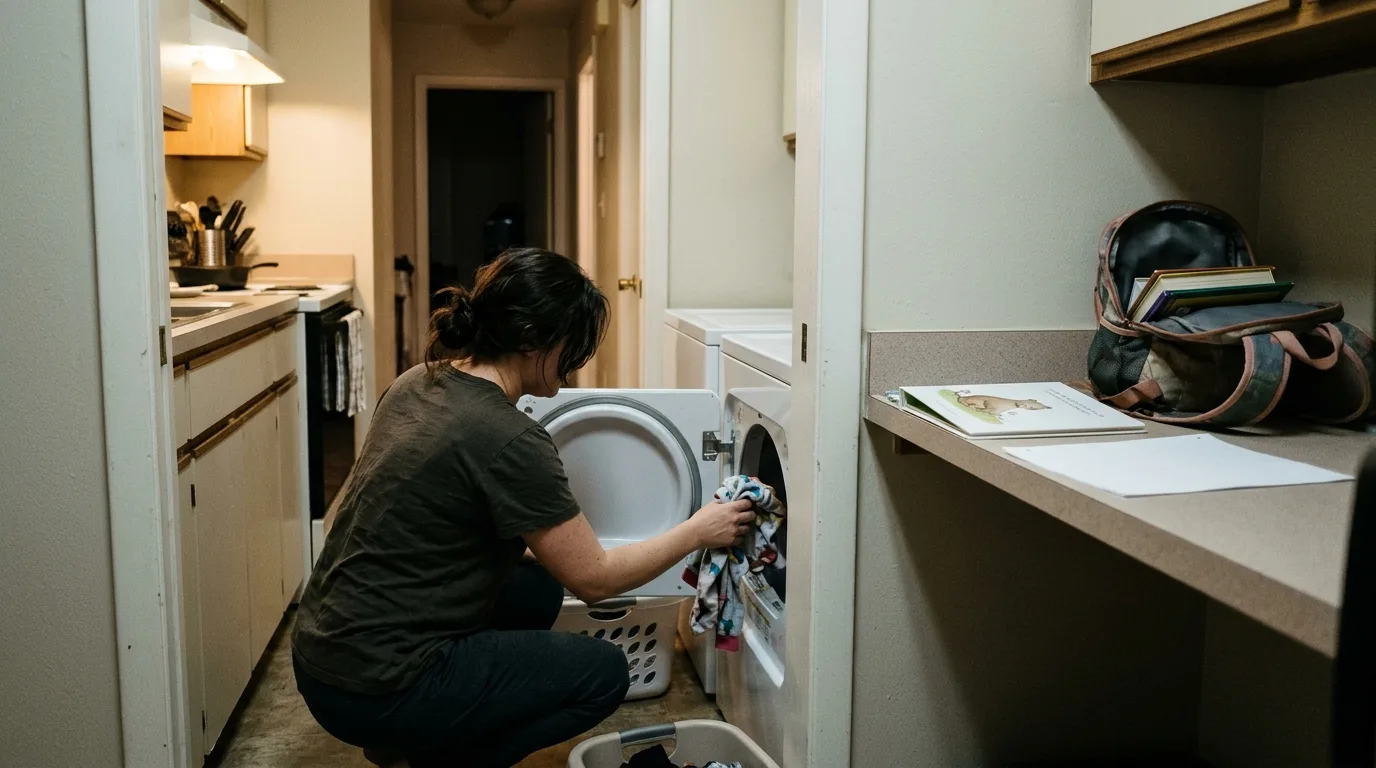
Bedtime lands on one parent because that parent holds the plan, and nobody sees the plan. Your partner can do the bath every night and still be a guest in the routine if you're the one who knows the pajamas are in the dryer, the library book is due Thursday and the reading log needs a signature.
Night-time care is still lopsided. A 2025 study in the journal Children looked at 882 sleep-clinic files for children up to age 5. In 60%, only the mother handled nights; in 9%, only the father. In a separate group of 1,409 mothers, the split was 64% and 6%. The gap held when both parents worked full-time and when the child was no longer breastfed, and only 7% of fathers of children over 3 took responsibility for nights.
Daytime care leans the same way. In the US government's 2024 American Time Use Survey, women living with children under 6 spent 3.0 hours a day on primary childcare, which includes bathing and feeding, against 2.0 hours for men. The planning is more uneven still. A University of Bath study of US parents found mothers handled 71% of household mental-load tasks, such as planning meals and arranging activities.
Researchers Ana Catalano Weeks and Leah Ruppanner sort parents' mental load into two kinds: core work that returns every day, and episodic work that turns up now and then. Bedtime is core. It comes back every evening, so the parent who holds it never gets a night off from thinking about it, even on nights they skip the bath. A later paper, “Take a Load Off? Not for Mothers”, looks at why the changes that shift who does physical housework don't shift the thinking work as much.
Those studies mostly count mothers and fathers. In any couple, the pattern can start the same way: one person learned the routine first, and the knowledge stayed with them. Beyond bath, teeth and story, that knowledge usually covers:
- Clean pajamas in the drawer, which means someone noticed the laundry pile
- Diapers or pull-ups, toothpaste and bath wash restocked before they run out
- The next book chosen and the library books returned
- The reading log signed and the permission slip in the folder
- Tomorrow's clothes laid out, school bag packed, water bottle washed
- Any medicine or vitamins your child takes at night
- The current quirks: which stuffed rabbit, which song, how far the door stays open
- Getting up for wake-ups after lights-out
- Keeping track of whose night it is
Count how many of those sit with you. If it's most of them, taking turns on the bath won't make you less tired.
Should we split bedtime by steps or take turns each night?
Take turns with whole nights if your evenings look alike and one adult can manage every child at once. Split by steps if you're both home at bath time and one of you alone gets swamped. Guidance from Children's Mercy Kansas City recommends alternating nights so both parents stay involved and each gets a real break, and agreeing on the split together so neither feels overwhelmed. That suits one child, or two close in age. With a baby and a preschooler, a solo bedtime can turn into a long slog, and splitting by child or by step is kinder to whoever is on.

- Alternate whole nights
- One parent does everything from bath to lights-out, plus that night's wake-ups; the other is fully off. Suits one child or kids close in age, and parents with similar evenings. Watch for: the off-duty parent still being called in.
- Own the parts every night
- Each parent has fixed steps, such as bath and teeth versus stories and lights-out. Suits two or more kids when both of you are home by bath time. Watch for: nobody ever gets a full night off.
- One parent per child
- Each parent puts down one child, start to finish. Suits a baby plus an older sibling. Swap children weekly so one of you isn't always on the harder bedtime.
- Swap parts weekly
- Like owning parts, but you trade steps every week. Suits couples where one parent doesn't know the full routine yet. Watch for: more to remember, so write it down.
- Jobs after lights-out
- None of the models above assigns these. Give each one (laundry, tomorrow's bag, restocking, wake-ups) a single owner, whichever model you choose.
Here's how one parent per child might run for an illustrative family with a 1-year-old and a 5-year-old. Week one, you take the baby: bottle, diaper, sleep sack, down by 7. Your partner takes the 5-year-old through bath, teeth and two books, with lights out at 7:30. Week two, you swap, so neither of you gets the child who fights sleep every single night.
The row you pick decides who is in the room at 7pm. It doesn't decide who washes the pajamas. The steps below cover that.
How to split the bedtime routine with your partner, step by step
You can split the bedtime routine with your partner in six steps: list every job, pick a model, give each job one owner, define done, say it out loud, then run it for a week. A pen and the back of an envelope will do. FairShare, our free iPhone app for sharing the mental load, makes steps 1, 3, 4 and 6 faster, and each of those steps says how.
Step 1: Write down every bedtime job, including the ones after lights-out
Step 2: Pick one split to test for seven days
Step 3: Give each job one owner, start to finish
Step 4: Agree what done means for each part
- Bath: kid washed, toys out of the tub, wet towel hung up, floor wiped
- Teeth: brushed with the timer song, brush rinsed and back in the cup
- Stories: two books, then the song, even when they ask nicely for a fifth
- Lights-out: by 7:45, night light on, door open a hand's width
- Tomorrow's bag: reading log signed, any form in the folder, water bottle washed and in the side pocket
- Night wake-ups: on your night, you get up, and the other parent stays in bed even if they hear it
Step 5: Bring it up without starting a fight
Step 6: Invite your partner in and run it for a week
What if our kid only wants one of us at bedtime?
If your child cries for you, hand bedtime over in stages and be out of the room by the last one, instead of switching cold on a Monday. Protests in the first few nights are a reaction to a changed routine, so give it time before you judge the split.
- Your partner does the first step, usually the bath, while you do everything after it.
- Your partner does bath and pajamas; you do the story and lights-out.
- Your partner does the whole routine; you say goodnight early, then leave the room.
- Your partner does the whole routine while you're out of the house on a walk, an errand or at the gym.
Move to the next stage when the current one goes calmly, not on a fixed date. On your partner's nights, stay out of earshot if you can. If you're in the next room, your child learns that a loud enough protest might bring you back. Your partner can repeat one steady line, such as “You'll see [your name] at breakfast. Tonight it's me and the dinosaur book,” and carry on with the routine.
Night wakings are where a split is easiest to lose. The Children study found that the number of night awakenings and the child's age both shaped who ended up doing night care, so a rough patch of wakings is exactly when one parent quietly becomes the night parent again. Decide in advance that whoever has bedtime also has that night's wake-ups. If your child wakes a lot or bedtime is a battle every night, raise it with their doctor. This guide covers how to share the work. It can't diagnose or fix a sleep problem.
How do we keep the split from sliding back to one parent?
Look at the split every week, before resentment builds, and treat every change as a trade instead of a favor. FairShare's weekly check-in takes 15 minutes and walks you through short prompts: what shifted this week, which nights or cards you swapped, whether a definition of done needs updating, and anything you want to renegotiate. The same questions work on paper. Our guide to running a weekly household check-in that doesn't blow up has the full version.

Late meetings, shifts and travel
- Late meeting on your night: swap, don't borrow. “Can you take Tuesday? I'll take Thursday” is a trade. “Can you cover Tuesday?” turns into a debt nobody tracks.
- Evening shifts: the parent who's out most evenings owns the jobs they can reach, such as the pajama laundry, restocking diapers, library holds and the morning bag check. The parent at home does bedtime without also having to remember everything around it.
- Travel: the traveling parent keeps the jobs that work from a hotel room, like ordering diapers or signing a school form online, and takes the first two bedtimes when they get home.
Watch for “just reminding.” If you catch yourself texting “did you sign the reading log?”, the noticing has moved back to you, and so has the card. Raise it at the check-in, not at 8pm. FairShare shows who's carrying what, so on Sunday you can point at the cards instead of arguing about a feeling.
You don't need FairShare to do this. If a whiteboard on the fridge already keeps you both on track, keep the whiteboard. If your partner doesn't use an iPhone, a shared note does the job. And if one of you won't engage at all, no list will change that, and a couples counselor is a better next step. If you both work full days, our guide to a fair reset for working parents covers the rest of the evening, not just bedtime.
Common questions
What bedtime jobs can my partner do if I'm breastfeeding?
Who should get up with the kids at night when both parents work?
Is it OK if each parent does bedtime a bit differently?
How do two parents split bedtime with a toddler and a baby?
My partner says they'll help with bedtime but never takes over. What do I do?
Should siblings do bedtime together or one at a time?
Tonight, before you go to sleep, write the list: every bedtime job from the toothpaste to the 2am wake-up. Tomorrow, show it to your partner and pick one row from the table to try for a week. If you set it up in FairShare, read our tips for your first two weeks with FairShare first.
Sources
- Gender Inequality in Managing Childhood Sleep: Which Parent Gets up at Night? (full text)
- American Time Use Survey — 2024 Results (USDL-25-1060)
- Mothers bear the brunt of the 'mental load,' managing 7 in 10 household tasks
- A typology of US parents' mental loads: Core and episodic cognitive labor
- Take a Load Off? Not for Mothers: Gender, Cognitive Labor, and the Limits of Time and Money
- Brain full? How parents are lightening the mental load
Keep reading
More FairShare guides



Written by the FairShare team. Drafted with AI assistance and reviewed by a human editor before publishing.