
What's the best way to split the mental load with your partner?
- Capturing tasks fast
- Shared list app: free, and the iOS 26 version suggests reminders for you
- Showing who plans, not just who does
- Mental-load card app, with Conceive, Plan and Execute on every card
- Agreeing what “done” means
- Card deck or card app. Lists and charts skip this step
- Still working after week three
- Card app with a 15-minute weekly check-in
- A first honest conversation
- Paper card deck spread out on the floor
- Risk of scorekeeping
- Highest with points-based chore apps
- Works if only one partner joins in
- Shared list only. Every other option needs two
Most couples reach for a tool when the real argument is about something most tools never count: who notices. Researchers call it the mental load, or cognitive labor. In a study of 3,000 US parents in the Journal of Marriage and Family, mothers handled 71% of household mental-load tasks and fathers 45%. The figures add up to more than 100 because many tasks are shared. For daily jobs like cleaning and childcare, the split was 79% to 37%.
Money doesn't close the gap. A follow-up study of 2,133 partnered parents, published in October 2025, found that mothers earning more than $100,000 reported 30% less childcare and 17% less housework than lower-income mothers, and no less mental labor. You can hire a cleaner. You can't hire someone to remember the cleaner is coming on Thursday.
Two full-time jobs don't close it either. Among different-sex couples where both parents work full time, 52% say the mom does more of the parenting tasks and 39% say the split is equal, according to Pew Research Center's June 2026 survey. So we judged each approach below by one test. Does it move the noticing and planning, or only the doing?
Is a shared list app enough to split the mental load?
For capturing tasks, yes, and it costs nothing. The Reminders app built into iOS 26 now suggests reminders it spots in your emails and other text, and sorts lists into categories on its own, so a grocery list arranges itself without you touching it. In iOS 26.2, an urgent reminder can also sound an alarm that breaks through Focus modes.
That takes care of remembering. It doesn't touch the harder part. A shared list shows what needs doing. It doesn't show who thought of it, who is checking the details, or who will chase it when it slips. You can share a list with your partner, and the person who started it is usually still the one who noticed everything on it.
Take a line like “Book dentist.” Someone noticed the six-month mark had passed. Someone will check which days the clinic has evening slots, compare them with soccer practice, and find the insurance card. The list holds two words. The work behind them stays in one person's head.
Pick a shared list if the split already feels fair and you only need a common memory, or if your partner isn't ready for a dedicated tool yet. It's a fine first step. It won't fix an uneven split.
Do chore charts and chore apps fix who does more?
They fix the doing, and for kids they work well. A magnet chart on the fridge makes it plain who emptied the dishwasher. But a chart counts finished jobs, and finished jobs are the part of home life that money and effort already shrink. The mental load is the part that stays put.
There's a second problem. Partners tend to believe they do more than they do. In the same 3,000-parent study, fathers asked in a single question estimated they carried 61% of the mental load. A detailed 21-item checklist put them at 45%. Mothers overestimated too, 78% against a checklist figure of 71%. A chart that tallies dishes and trash runs can't settle that disagreement, because nobody ticks a box for “remembered the dog's vaccine was due.”
Points-based chore apps add a risk of their own. Once every task carries a score, one hard week turns into an audit, and you end up arguing about the tally instead of the work.
Pick a chore chart if you're handing out jobs to kids or housemates and the adults have already agreed who plans what.
What a paper card deck gets right, and where it stalls
The card-deck approach behind the Fair Play method gets the core idea right. Each card names a whole area of home life, like school forms or birthday gifts. Whoever holds the card owns all of it: noticing it needs doing, planning it, and doing it. You also agree on a minimum standard of care, so “done” means the same thing to both of you.
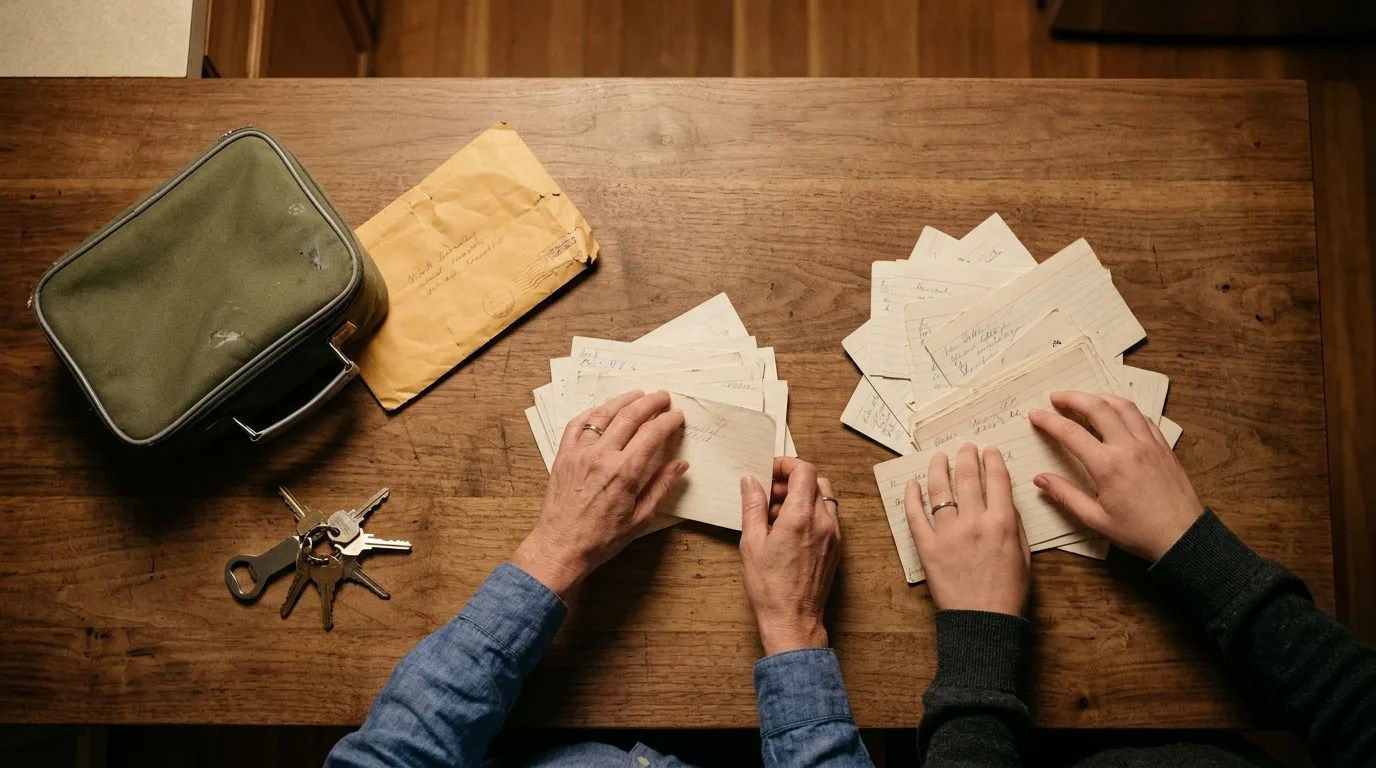
Spreading the cards across the floor is a strong way to start. A tall pile in front of one person makes the point faster than any argument. If you're not sure how to open that talk, read how to bring up the mental load without starting a fight before you deal a single card.
The deck stalls around week three. The cards go back in the box. Nothing prompts you to look again when a new job, a new baby or a school change reshuffles the load. On an ordinary Tuesday, paper can't show either of you who is holding what. Good intentions alone don't hold the split in place. Allison Daminger's research, drawn from interviews with more than 170 people across more than 80 couples, found that women carry most of the cognitive labor even in couples who set out to share it equally.
Pick a paper deck if you want one big conversation and you trust yourselves to come back to it without a nudge.
What a mental-load card app like FairShare adds
It keeps the card idea and adds what paper can't do. In FairShare, every card covers Conceive, Plan and Execute, so ownership is explicit instead of split by vibes. Each card states what “done” means. Your partner joins from an invite link in one tap, and the app shows who's carrying what. That last part goes straight at the overestimating problem, because you're both looking at the same picture instead of two memories.
Starting with what's already in your head
Most people can't list their mental load on demand. It comes back in pieces, usually at 11pm. Brain Dump is built for that. You empty out everything you're tracking, and FairShare's AI helps turn the jumble into cards you can sort and hand out. If you need prompts for what belongs in there, this list of invisible tasks couples forget to count will jog your memory.
Here's an illustrative example, not a real customer. Dana is the one who knows when the car registration is due, when the dog's flea treatment runs out, and which kid has outgrown which shoes. On a Sunday night she empties all of it into Brain Dump. Her partner joins from the link she texts him. At their first check-in he takes the car card whole, from spotting the renewal notice to the new sticker on the windshield. They write down what done means: renewed before the due date, with no reminder from Dana.
The 15-minute weekly check-in
This is the piece that keeps the split from drifting back. Once a week, short prompts walk you through what shifted, any swaps, updates to your minimum standards, and anything you want to renegotiate. It takes fifteen minutes on a set day, so problems come up before they turn into a fight. For a format that works with or without an app, see how to run a weekly household check-in that doesn't blow up. To make your first cards, follow the FairShare setup guide, from first open to first check-in.
Pick a mental-load app if one of you is the household's default noticer and you both want that to change.
When a mental-load app is the wrong choice
- Your partner won't take part. Every approach here except a shared list needs two willing people. An app can't make someone care. Once they do care, it shows the picture clearly.
- You only need a grocery list. The free reminders app on your phone handles that well now.
- Your partner isn't on iPhone. FairShare is an iPhone app, so in a mixed household a list that works on both phones is the practical choice.
- Every chore conversation already ends in a fight. Fix the conversation first. Making ownership visible can sting before it helps.
- The real goal is getting the kids to do their jobs. A chart on the fridge beats any adult planning tool for that.
Common questions
Can I use the iPhone Reminders app to split the mental load?
What's the difference between the mental load and household chores?
Do we need the Fair Play card deck to use FairShare?
My partner thinks we already split things evenly. Will an app help?
How much time does FairShare take each week?
Sources
- A typology of US parents' mental loads: Core and episodic cognitive labor
- Take a Load Off? Not for Mothers: Gender, Cognitive Labor, and the Limits of Time and Money
- How working parents divide family responsibilities
- Women carry a household's mental load. Now, a Wisconsin researcher has receipts.
- Here's everything new for Reminders in iOS 26
- Everything new in iOS 26.2 beta 2
Keep reading
More FairShare guides

Written by the FairShare team. Drafted with AI assistance and reviewed by a human editor before publishing.